Happy Hours, Part 1 — Tribeca Review
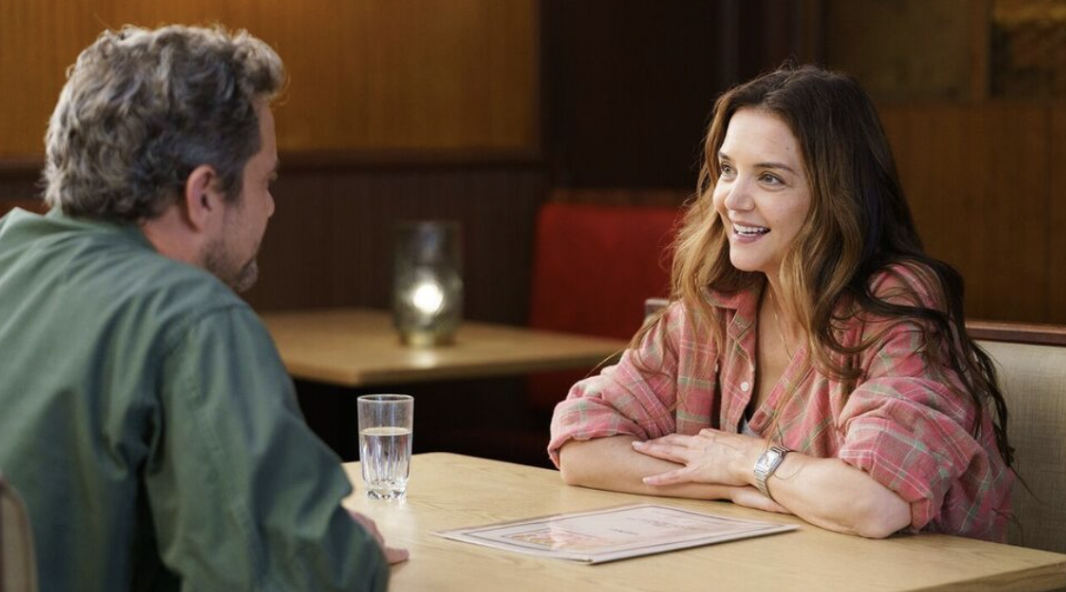
Source: Tribeca
Katie Holmes’ latest endeavor is an ambitious one: writing, directing, and starring in a romance trilogy. Happy Hours sees her reuniting with her Dawson’s Creek co-star Joshua Jackson. The two still share some chemistry after all of these years, yet that’s not enough to salvage a subpar screenplay.
Happy Hours, Part 1 begins with a quote from one of my favorite books, The Wisdom of Insecurity: A Message for an Age of Anxiety by Alan Watts, which reads: “But, as a matter of fact, you cannot compare this present experience with a past experience. You can only compare it with a memory of the past, which is a part of the present experience.” Now that the film is over, I’m grateful that Happy Hours, Part 1 is only a memory of the past. Its runtime may only be an hour and twenty minutes, but those hours spent in the theater were anything but happy.
The film follows Liz (Katie Holmes), a photographer, as she reconnects with her first love, Andrew (Joshua Jackson), a travel writer. The film weaves in flashbacks from their youth, with Johnna Dias-Watson playing Liz and Jack Martin as Andrew. It’s clear from the start that there are lingering, unresolved feelings between the two, with the flashbacks providing context for how their romance ultimately fell apart. The Alan Watts quote at the start of the film suggests that it will be a more profound, philosophical meditation on memory—namely, that we cannot relive the past and that people may remember the same events differently. Instead, the film feels painfully surface-level in its execution, favoring melodrama over anything more meaningful.
The screenplay has its fair share of humorous exchanges, but it mostly consists of moments meant to be sincere that end up being so cheesy and cringe-inducing that audience members, myself included, couldn’t help but laugh. The performances only heighten the awkwardness of the dialogue. The dramatic beats come across as forced, and the emotional scenes feel empty. It’s clear that Holmes drew inspiration from Richard Linklater’s Before trilogy, as the film wears its influences on its sleeve. However, Happy Hours, Part 1 plays out more like a Tubi Original version of the Before trilogy, due to its stilted execution and amateurish quality. The schmaltzy sentimentality also places it closer to a Hallmark or Lifetime movie.
One of the most refreshing and admirable aspects of the film is its deaf representation, as Andrew and his friends use American Sign Language (ASL) to communicate. It’s rare to see a film with deaf characters where their deafness isn’t integral to the plot; they’re simply allowed to exist as people rather than having their disability define them. As a result, this feels like the type of necessary deaf and ASL representation we need more of in the media.
Joshua Jackson is the film’s greatest strength. He brings an effortless charm to Andrew and does his best to sell both the romance and the character’s emotional vulnerability. His chemistry with Holmes is one of the few aspects of the film that feels genuine. Still, there’s only so much he can do with the material he’s been given. The screenplay struggles to establish clear character motivations, making many of the characters’ decisions feel arbitrary or inconsistent. As a result, the narrative meanders from one conversation to the next without much dramatic momentum. The story is also weighed down by familiar romantic clichés, many of which feel recycled rather than insightful.
The cinematography is serviceable but seldom memorable. Despite following a photographer and a travel writer, the film lacks a strong visual identity and fails to take advantage of its iconic New York City settings. The music from Norah Jones is strong, but often feels out of place. Combined with the film’s clunky dialogue and uneven performances, these technical shortcomings further prevent Happy Hours, Part 1 from achieving the emotional impact it strives for.
What’s ironic is that Happy Hours, Part 1 seems deeply interested in how we remember past relationships, yet it offers little insight into memory, nostalgia, or second chances beyond familiar romantic platitudes. While Katie Holmes deserves credit for the ambition of launching a self-written, directed, and starring trilogy, ambition alone cannot compensate for a weak screenplay. For a film about memories, Happy Hours, Part 1 isn’t particularly memorable. As the first chapter in Holmes’ planned trilogy, it’s an unconvincing start and struggles to get viewers invested in the characters as well as their relationship. Ultimately, Happy Hours, Part 1 serves as proof that not every past romance is worth revisiting.
Happy Hours, Part 1 premiered at Tribeca on June 6, 2026.