Mineshaft: The Cruising Murders — Tribeca Review
Source: Tribeca
If ever there was a movie deserving of a companion documentary, it is Cruising, William Friedkin’s 1980 queer crime thriller. The film was steeped in controversy upon its release but is now widely revered as a classic. It was also partially inspired by the murder of Addison Verrill, blurring the line between fiction and real-life tragedy. What’s even more fascinating, however, is that Verrill was a film reporter for Variety who had written about Friedkin’s The Exorcist (1973), and the man who murdered him, Paul Bateson, had appeared in that very film. This astonishing chain of associations only deepens the intrigue surrounding Cruising and its origins.
Jeffrey Schwarz’s documentary, Mineshaft: The Cruising Murders, should be deemed mandatory viewing for Cruising fans and detractors alike. Schwarz approaches the material with remarkable objectivity, curiosity, and sensitivity. As a result, the documentary functions as both a compelling true-crime investigation and a fascinating historical examination of New York’s LGBTQIA+ community during a pivotal moment in its history. Composed of talking-head interviews, clips from Cruising, and an extensive collection of news articles, archival footage, and photographs, the film presents a comprehensive and well-rounded exploration of its subject matter.
Similar to how Jane Schoenbrun’s Teenage Sex and Death at Camp Miasma explores how transphobic media can simultaneously function as a source of harm and sexual awakening, Mineshaft: The Cruising Murders sheds light on the complex and often contradictory legacy of Cruising. Members of the queer community protested the film upon its release, viewing its depiction of homosexuality as deeply detrimental and pernicious. Yet for others, Cruising represented their first encounter with unapologetically gay imagery and desire in mainstream cinema. Thus, the documentary demonstrates how vastly different reactions to the film can coexist and be equally valid. It was groundbreaking in its portrayal of openly gay, masculine, and kinky sexuality in a major studio production, while at the same time perpetuating stereotypes that many found damaging. Beyond reinforcing these stereotypes, many critics also argued that the film implicitly linked gay sex with murder, intensifying concerns about its broader cultural impact.
Much of the film is anchored by interviews with figures connected to the New York queer scene of the late 1970s and early 1980s, particularly those who frequented the Mineshaft, a private BDSM club that became central to the mythology surrounding Cruising. Several of the interviewees also had personal connections to William Friedkin, Addison Verrill, and/or Paul Bateson, lending the documentary a more intimate, firsthand account of the events and cultural milieu it explores. The documentary also features a range of filmmakers and activists who reflect on Cruising’s legacy and its impact on cinematic depictions of homosexuality, adding an additional layer of industry commentary.
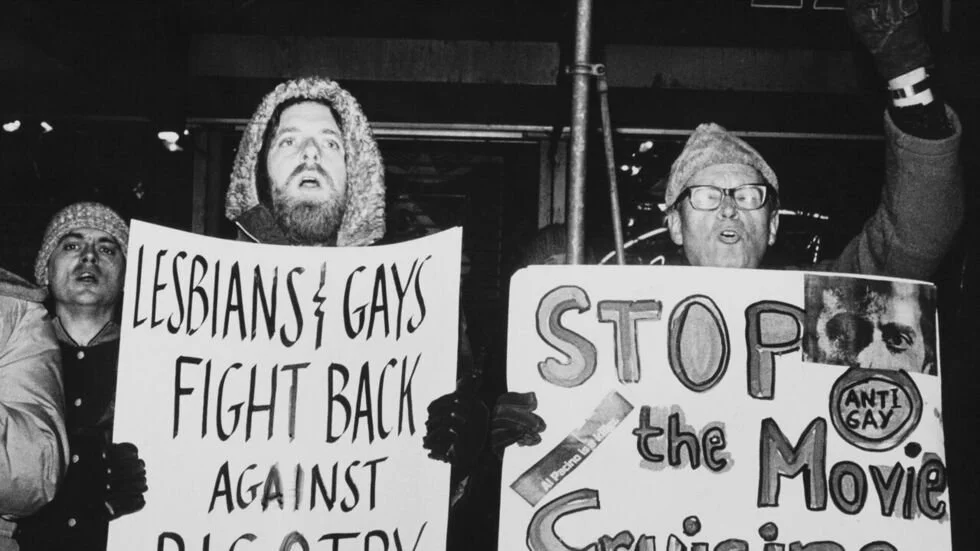
Don Scardino, who plays Ted Bailey in Cruising, reflects on his excitement about acting alongside Al Pacino. His recollections are interspersed with archival footage of protestors chanting, “Hey, hey! Ho, ho! The movie Cruising’s got to go!”, emphasizing the intensity of the backlash surrounding the film’s production and release. Scardino even remarks, “The filming of Cruising became like a battle zone.” Archival footage also depicts journalist and LGBTQ+ activist Arthur Bell arguing that a film like Cruising could provoke real-life attacks on gay men, as he alerted other journalists to the contents of the screenplay.
The controversies surrounding Cruising are intrinsically tied to the time period in which the film was made. If a film like Cruising were released today, it would likely generate far less backlash, given the increased visibility and abundance of queer media. In 1979, however, depictions of gay men in mainstream cinema were still relatively rare, and for many viewers, it felt especially fraught that one of the first major Hollywood portrayals of homosexuality centered on murder. At the same time, the film’s imagery of leather bars and coded sexual spaces reflects a specific moment in New York’s queer nightlife, where subcultures like the leather scene were both highly visible within their own communities and largely invisible to the outside world. Thus, it introduced some closeted viewers to a world of unapologetic homosexuality and kinky desire that they may not have otherwise encountered, and it employed numerous gay men as extras. In retrospect, these spaces were also inevitably shaped by the AIDS crisis, which would soon transform both queer nightlife and how this period is remembered and represented.
Mineshaft: The Cruising Murders does not attempt to settle the debates surrounding Cruising, nor does it offer a definitive reading of the film’s intentions or impact. That’s precisely what makes the documentary so effective. It paints a comprehensive picture of Cruising, offering a wide range of perspectives and voices. By bringing together figures from the queer nightlife scene, filmmakers, activists, and those connected to the production and the real-life murder that inspired the film, the documentary constructs a layered account that is simultaneously historical, personal, and cultural. Schwarz’s film chronicles the controversy surrounding Cruising and its legacy while also serving as both a true-crime investigation and a record of queer cultural history. Ultimately, Mineshaft: The Cruising Murders is one of the most riveting documentaries of the year, and a must-see for anyone interested in Friedkin’s film, whether they love it or hate it.
Mineshaft: The Cruising Murders premiered at Tribeca on June 6, 2026.