Behemoth! — NYFF Review
Source: Searchlight Pictures
There are multiple ways to interpret the title Behemoth!, the latest film from Michael Clayton (2007) director Tony Gilroy. On the surface, it references something within the story itself, but I’ll refrain from elaborating in order to keep this as spoiler-free as possible. The word behemoth comes from the Bible’s Book of Job and typically describes something massive or powerful, whether it’s a creature, person, or organization. It feels like a fitting word to describe an orchestra coming together to play a piece of music. You have all these individuals from all different walks of life, each playing their own instrument, yet once the music begins, it's as though they merge into one enormous entity, something larger than the sum of their parts. During the press conference at the New York Film Festival, Gilroy explained that when you sit in on a scoring session, you’ve got a huge group of people who don’t dress or act alike, but when the light comes on, they become “this organism instantly right in front of you.” Behemoth! is a love letter to film scores and the people who come together to create them, and from a musical and technical standpoint, this might be Gilroy’s most ambitious film to date.
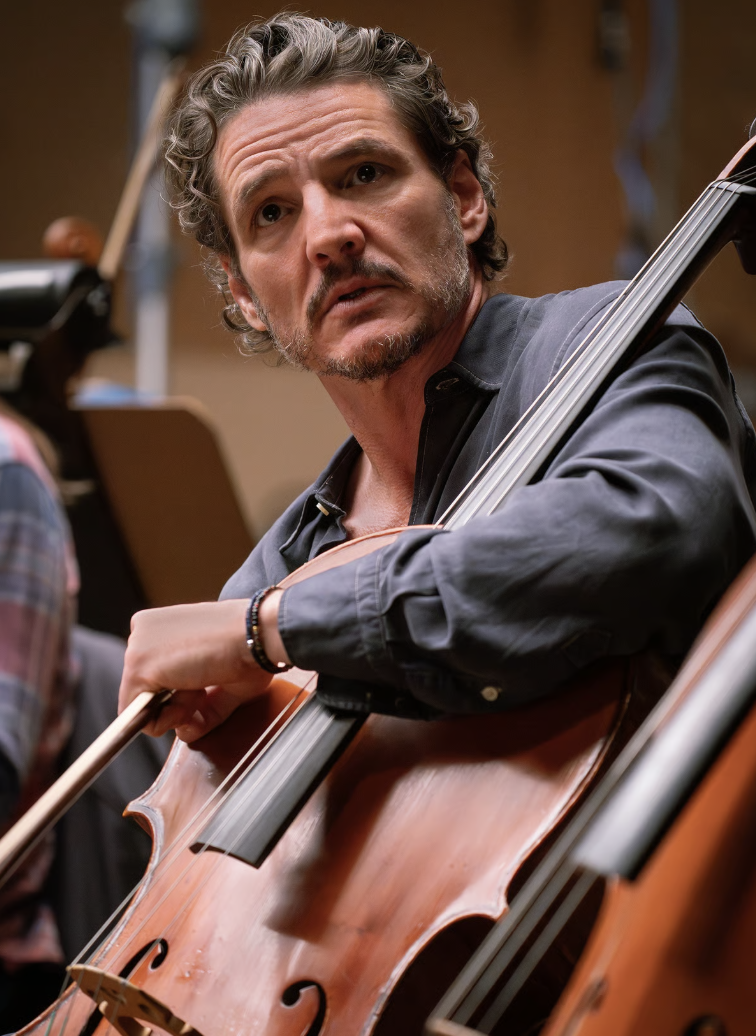
Despite how gargantuan the title sounds—especially with that exclamation point—the film zeroes in on one man’s life rather than an orchestra as a whole. Behemoth! follows Alex (Pedro Pascal), a cellist who returns to Los Angeles and quickly finds himself sucked back into the worlds of classical music and film scoring. He’s surrounded by fellow musicians, composers, and past lovers, but the film takes its time gradually revealing how the various parts of his life come together. Initially, it’s not entirely clear what story Gilroy is striving to tell. Alex works on film scores, performs as part of a symphony orchestra, and gets involved with numerous women. Rather than immediately establishing a central conflict, Gilroy slowly ties these different threads together until something larger eventually takes shape. In that sense, the screenplay deviates from the traditional three-act structure, feeling more like Alex is living his life, which can be a bit dramatic and messy at times, and we’re simply along for the ride.

Source: Searchlight Pictures
Gilroy’s storytelling approach here might not work for some viewers, as it takes a while to fully grasp what’s happening and who Alex is as a person. However, the more I think about it, the more I realize the narrative structure plays out like a musical composition. As Alan Watts once wrote, “You do not play a sonata in order to reach the final chord, and if the meanings of things were simply in ends, composers would write nothing but finales.” Life itself is like a piece of music; it’s not about merely rushing toward the finale, but appreciating the journey along the way. The story in Behemoth! feels like real life. It’s a series of movements and crescendos; sometimes there are harmonies, other times dissonance. It isn’t necessarily about where Alex ends up so much as it is about experiencing the moments and people he encounters in the process.
Pascal makes for a compelling lead. His ability to learn to play the cello alongside memorizing his lines is impressive, since he’s in virtually every scene of the movie. Alex is flawed enough to feel real yet likable enough to become emotionally invested in. He’s also somewhat enigmatic and a bit of a womanizer, which makes it difficult to get a complete read on him. The way the people in his life keep welcoming him back makes you wonder why he left in the first place and draws you into his story before the film’s central conflict even crystallizes. Eva Victor delivers a standout performance despite only appearing in a couple of scenes as Nadia, one of Alex’s colleagues he was romantically involved with. She possesses such a magnetic presence, making it understandable why Alex would be so drawn to her.

Source: Searchlight Pictures
The most noteworthy aspect of Behemoth! is naturally its music. Nine different composers worked on the score: James Newton Howard, Alan Silvestri, Brandon Roberts, Michael Abels, Emily Bear, Lukas Frank, Michael Giacchino, Henry Jackman, and Nami Melumad. Having so many composers contributing gives the score an expansive feel; it shifts between different sounds and moods while still remaining cohesive. Alex works on multiple film scores throughout the movie, and because the fictional films vary in genre and have different composers, each one needs to sound distinct. The music also feels firmly integrated into the story, with most of it being diegetic rather than simply playing in the background, immersing us in Alex’s world and line of work.
Behemoth! is a masterclass in how to use music and sound in a motion picture, especially when it comes to the editing. The score and sound design are immaculate, and the way they function in tandem with the editing is one of the film’s greatest strengths. John Gilroy’s editing has a rhythmic quality that complements the music, but it’s his use of audio match cuts that’s truly extraordinary. For example, the sound of someone knocking on a door becomes the beat of a drum, using that shared rhythm to transition seamlessly into the next scene. In another instance, a note from a song in a film scoring session transitions to characters playing “Happy Birthday” in a completely different time and setting.
Source: Searchlight Pictures
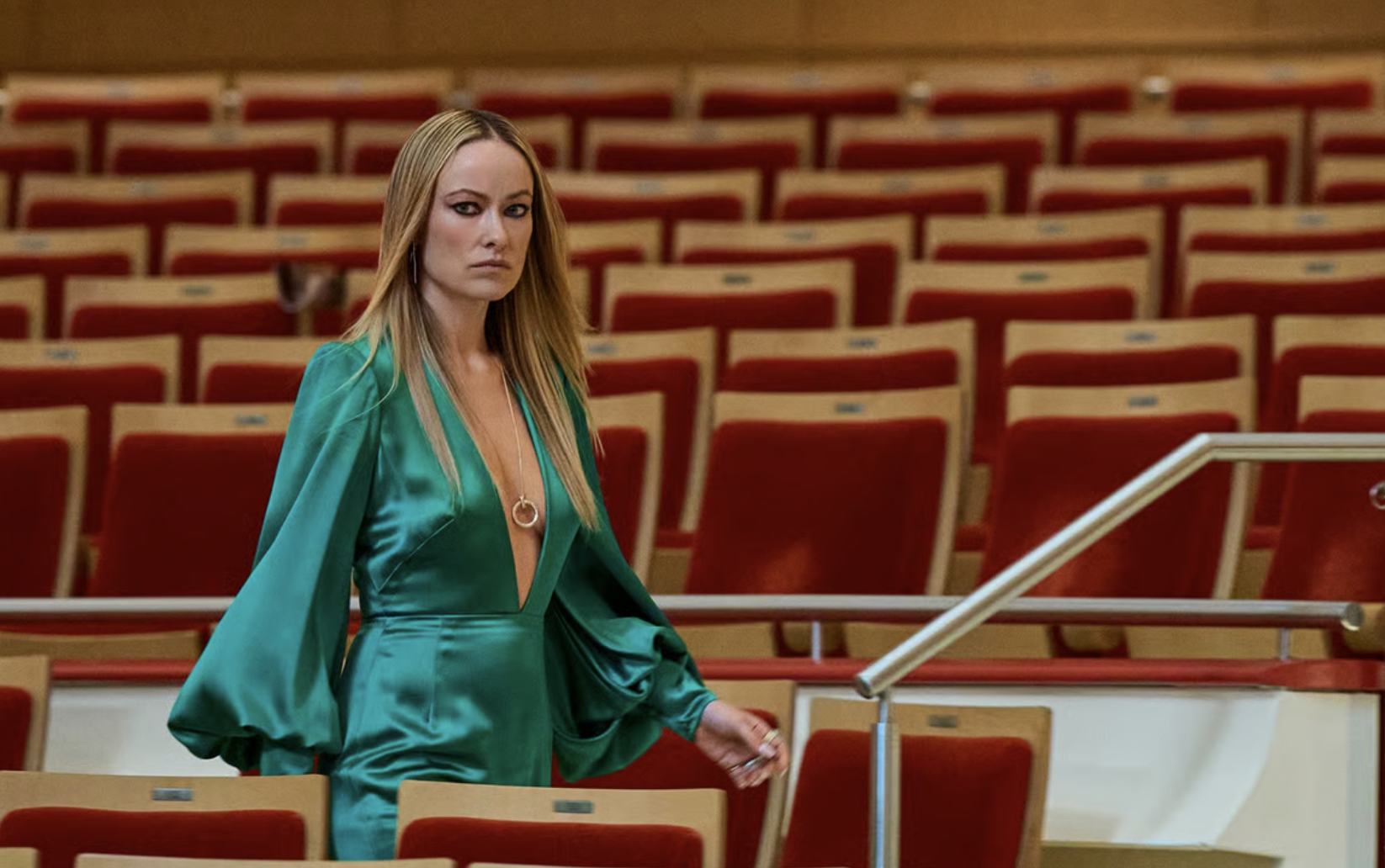
In addition, the editing is incredibly clever, making it feel as though Alex is playing the score for his own life. Early in the film, for example, he’s working on the score for what appears to be a chase scene, playing this tense, propulsive, heart-pounding music. While that music continues, the film cross-cuts to his jilted ex-lover, Carol (Olivia Wilde), relentlessly pursuing him at an event. The music heightens the intensity of the sequence as Alex desperately tries to get away unnoticed, but there’s also something amusing about watching Alex inadvertently compose the soundtrack to his own predicament. In another sequence, Alex is in his car listening to his brother Andy’s (Will Arnett) podcast, where he discusses music their father, Peter (Hank Azaria), composed. As Andy plays a clip from a piece their father wrote for a cartoon, Alex pulls up to Andy’s house and sees him and his wife fighting, with the music playing over the scene, making the argument feel like something straight out of a cartoon. Not only does it create one of the funniest moments in the film, but it also demonstrates how effectively Gilroy can use sound and music to tell Alex’s story.

Source: Searchlight Pictures
Behemoth! is also strong from a visual standpoint. Cinematographer Damián García’s imagery is stunning. Much like his main character, Tony Gilroy feels like a virtuoso, orchestrating the cinematography, score, sound design, and editing so that they work in perfect harmony to elevate the narrative. It’s as though Gilroy is the conductor and each element is a musician in the orchestra, with everyone coming together to create something far greater than any one component could achieve on its own. The film has a simple story, but its technical aspects make it special.
At one point, Alex tells Nadia, “This is your drama. You built all this. It’s your arrangement.” Whether or not that word choice was intentional, the film feels as though it treats people’s personal dilemmas like musical arrangements or compositions. It’s about the drama the characters orchestrate, as well as the clash between past and present. By returning home after years away, Alex is forced to face his past, whether it’s former lovers or family drama. At the same time, the film juxtaposes older, classical musical styles with modern instrumentation through the character Viviana (Alexa Swinton), a 15-year-old musical prodigy. Her unique style feels like it represents contemporary music, while Alex’s work feels more firmly rooted in tradition. Seeing these musical styles come together feels like a reflection of Alex’s life and how his past continues to influence his present.
The tagline for Behemoth! is “A life. In pieces.” It’s an apt description of both Alex’s life and the film itself. Gilroy presents us with seemingly disconnected fragments of Alex’s life, from relationships and family history to music and memories. Gradually these pieces merge together to form something cohesive. Behemoth! may take its time finding its rhythm, but there’s something fitting about a film so concerned with music asking us to appreciate the individual notes rather than simply rushing toward the final chord.
Behemoth! had its world premiere at the 64th New York Film Festival on Friday, October 2, 2026. It will be released theatrically on December 4th.
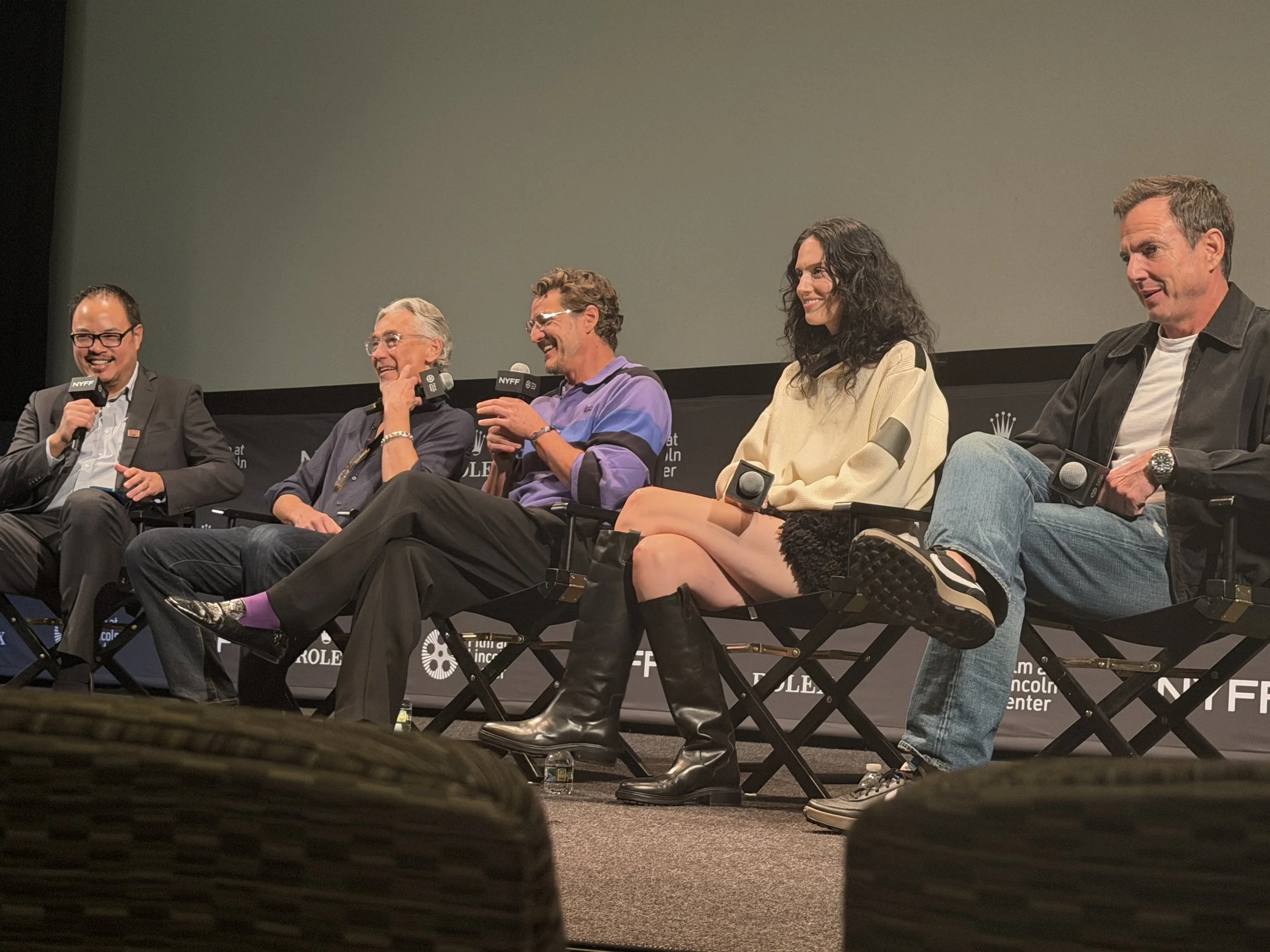
Tony Gilroy, Pedro Pascal, Eva Victor, and Will Arnett at the press conference for Behemoth! at the New York Film Festival on October 2, 2026.