The Day She Returns — NYFF Review
Source: Cinema Guild
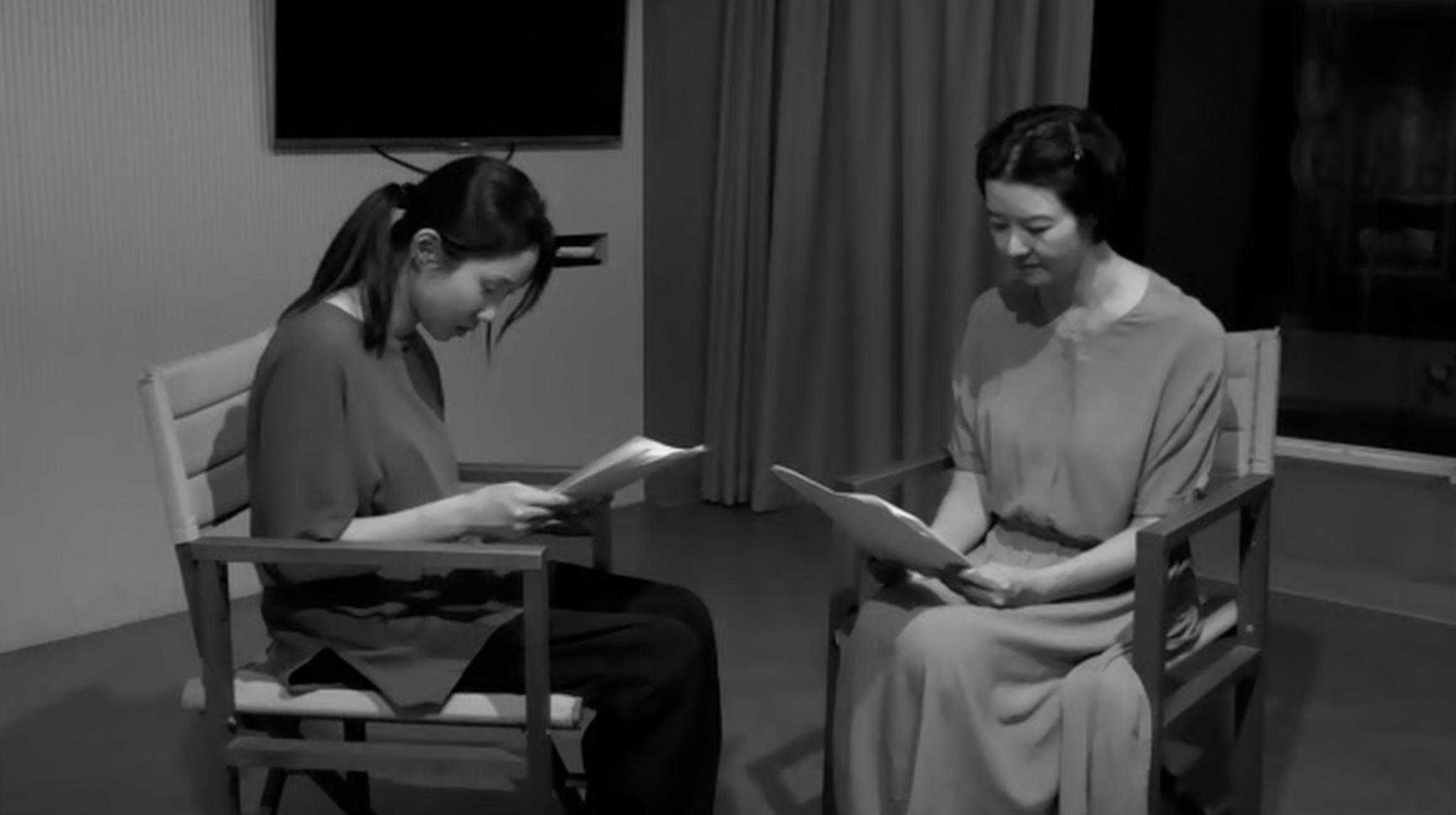
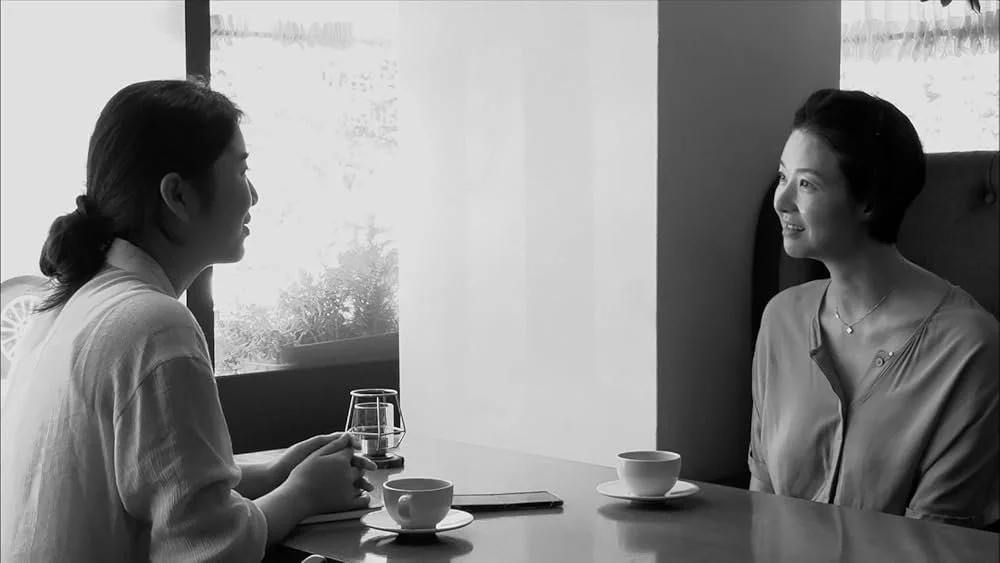
The Day She Returns, the latest film from Hong Sang-soo, fits perfectly into his oeuvre, delving into themes of repetition, memory, and the act of filmmaking itself. The film follows Bae Jeongsu (Song Seon-mi), a previously retired actress who has recently returned to work in an independent film. She participates in a series of press interviews to promote her upcoming project, with the film divided into separate chapters, the first three depicting three different interviews that take place at a German restaurant. Eventually, Bae Jeongsu is asked to recreate these interviews in an acting class, but she finds herself unable to remember exactly what was discussed.
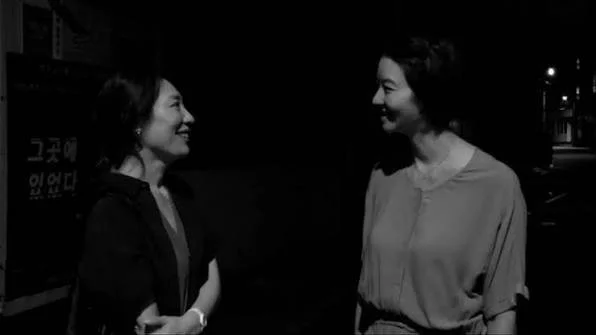
Hong Sang-soo’s cinematography here feels heavily inspired by the French New Wave, with its black-and-white photography and almost cinéma vérité style. Many of the scenes consist of long takes in which the camera remains completely static throughout an entire conversation. This makes the performances all the more impressive, as the actors have to sustain a natural rhythm and believable conversation within a continuous, unbroken take. The minimalist approach extends to both the film’s style and its plot, with Hong Sang-soo allowing seemingly mundane conversations to carry much of the narrative.
Source: Cinema Guild
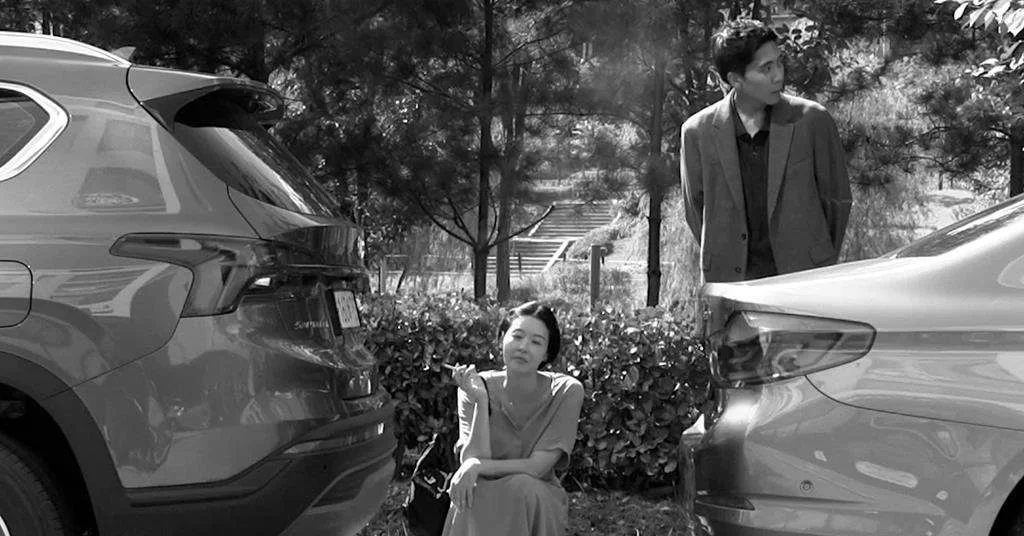
There are only a few camera zooms, making each one feel particularly noticeable, as if they were carefully planned out. Likewise, transitions into a new chapter are accompanied by music, often cutting to images of Bae Jeongsu crouching in the grass and smoking between interviews. These repeated images reinforce the film’s fascination with repetition and memory, as familiar moments are revisited but never quite recreated in exactly the same way. This idea is echoed during the first interview, when Bae Jeongsu remarks, “All interpretations ultimately lead to anxiety. If you can see things as they are, then you can actually experience real peace.” The repeated ideas and conversations throughout the film reflect this tension between experience and interpretation. Although the characters revisit the same subjects and conversations, each repetition can be interpreted differently.
Source: Cinema Guild
The conversations during the three interviews span a variety of topics, including beer, Buddhism, Taoism, dogs, and intermittent fasting. Despite their differences, each interview ends with the interviewer asking Bae Jeongsu if she has “any advice for young people.” She gives essentially the same answer each time, although her wording changes from one interview to the next. Her central message boils down to the idea that you should “love yourself the most.” The repetition of this sentiment, despite its slightly different phrasing each time, further emphasizes the film’s interest in how the same idea can take on different meanings.
During a Q&A at the Berlinale, Hong Sang-soo was asked about the inspiration for the film, to which he replied that he doesn’t usually start with a specific idea. Instead, he said that he began with the actors and then decided on a location. This process feels apparent throughout the film itself. The Day She Returns seems to gesture toward several ideas, including the current state of journalism, the film industry, and aging, but none of these themes feel fully fleshed out. Rather than developing a clear argument about any of them, Hong Sang-soo seems content to let the film’s repetitions and conversations speak for themselves, leaving the audience to determine their own meaning. Yet perhaps this lack of a definitive interpretation is itself the point. Much like Bae Jeongsu’s comment about seeing things as they are rather than interpreting them, perhaps The Day She Returns isn’t meant to have a singular interpretation at all. Perhaps it is simply what it is.
Source: Cinema Guild
Ultimately, The Day She Returns left me feeling more detached than intrigued. It embraces a sense of realism, but almost to a fault. The conversations are so naturalistic that they often become tedious and uninteresting. While this may be intentional, I found that the commitment to mundane, everyday interactions came at the expense of any real sense of momentum or dramatic engagement. The long takes are formally impressive, but The Day She Returns is a frustratingly slight film. Its themes of repetition, memory, filmmaking, aging, and interpretation are interesting in theory, but it rarely develops those ideas into anything substantial. If all interpretations ultimately lead to anxiety, perhaps The Day She Returns isn’t meant to be interpreted at all. As Bae Jeongsu states, “If you can see things as they are, then you can actually experience real peace.” Maybe the movie really is best experienced exactly as it is: a series of understated conversations, repeated ideas, and ordinary moments. For me, though, there simply wasn’t enough beneath the surface to make that experience compelling. Ironically, I find myself running into the same problem with this review: it feels repetitive, much like the film itself, and there is only so much I can say about a film that doesn’t have much to say.
The Day She Returns will have its North American premiere at the 64th New York Film Festival on October 6, 2026.